
The State of America's Direct Support Workforce Crisis 2026
Decades Into America’s Disability Services Workforce Crisis, Providers See Little Progress as States Face New Medicaid Funding Pressures
Share this page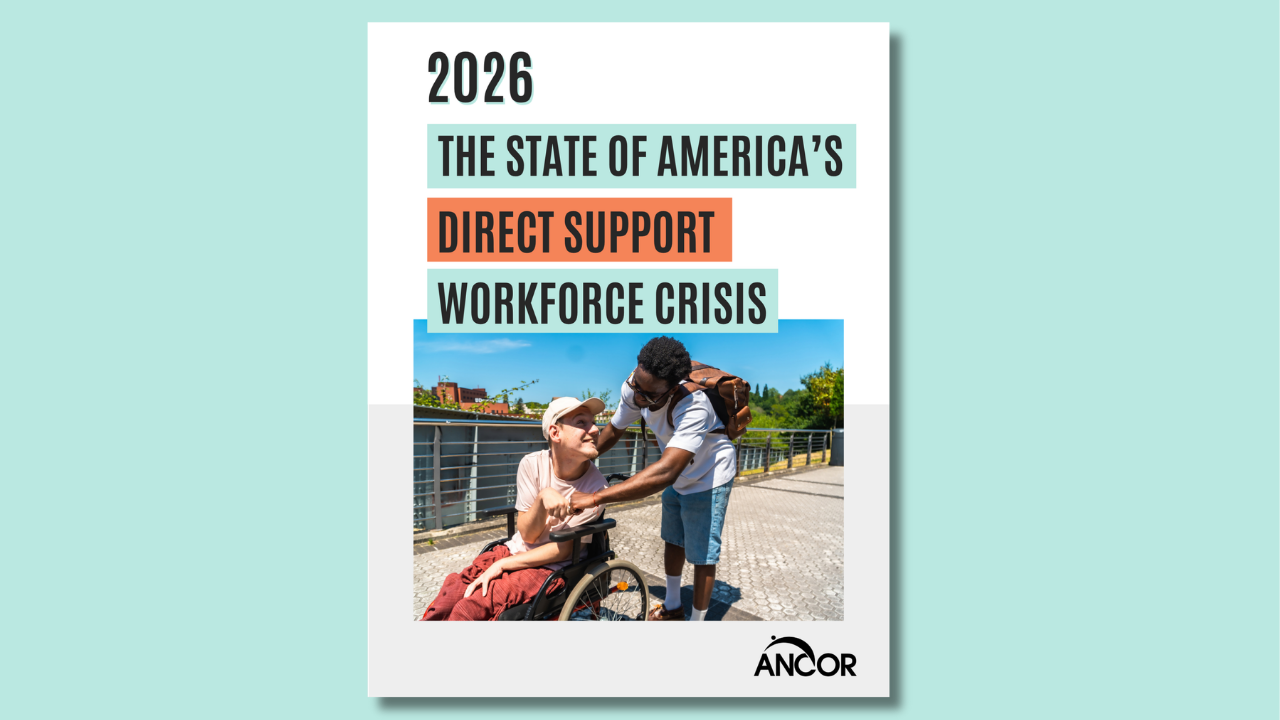

ANCOR’s new report points to a future where services for people with intellectual and developmental disabilities may exist on paper, but be impossible to access in practice
Nationwide – Today ANCOR, the leading voice in Washington for providers of long-term support services for people with intellectual and developmental disabilities (I/DD), released its seventh annual State of America’s Direct Support Workforce Crisis report, finding that decades into a nationwide workforce crisis, the system is showing few meaningful signs of recovery.
Based on responses from 524 disability service providers across all 50 states and the District of Columbia, the indicators ANCOR has tracked for years remain stubbornly high: 85 percent of providers experienced moderate or severe staffing challenges in the past year, 55 percent turned away new referrals because they lacked sufficient staff, 29 percent discontinued programs or services to people already accepting support, and 57 percent delayed the launch of new programs.
Decades into a nationwide workforce crisis, providers remain unable to recruit and retain enough direct support professionals (DSPs) to meet existing demand, with nearly half (48 percent) considering additional program cuts if workforce challenges persist.
Alarmingly, these findings capture the state of the system before states have fully confronted the consequences of massive cuts to federal Medicaid funding passed last year.
Medicaid is the primary funder of community-based disability services, and inadequate reimbursement rates have long limited providers’ ability to offer wages and benefits that compete with other hourly wage industries. New federal restrictions on Medicaid funding are now putting additional pressure on state budgets. Home- and community-based services are particularly vulnerable to further cuts because, unlike many other Medicaid benefits, they are not federally mandated.
The uncertainty of what existing and potential funding cuts will bring is already shaping providers’ operational decisions. Fifty-six percent of respondents said the threat of state reimbursement reductions or service cuts stemming from last year’s budget reconciliation law influenced their decision not to expand services this year.
“The most troubling finding in this year’s report is how little has changed,” said Barbara Merrill, chief executive officer for ANCOR. “Year after year, providers are telling us that they cannot find enough workers, that they are turning people away, and that they are eliminating or delaying services because they do not have enough staff to deliver those services. A crisis does not become less serious simply because it becomes familiar.”
“We have reached a dangerous equilibrium where crisis conditions have simply become the norm,” Merrill continued. “Now we are asking this already-fragile system to absorb another shock. States are only beginning to grapple with how federal Medicaid cuts will affect their budgets and the services they can sustain. There is no cushion left. Providers are already stretched beyond capacity, workers are already burning out and people with disabilities are already struggling to find the support they need.”
Lydia Dawson, ANCOR’s vice president for government relations and one of the report’s co-authors, added: “If policymakers allow Medicaid funding pressures to deepen this workforce crisis, the consequence will be fewer services, fewer choices and fewer opportunities for people with disabilities to live independently in their communities. Policymakers should be working to rebuild the capacity of this system, not introducing additional instability that makes it even harder for providers to recruit workers and serve people with disabilities.”
The impacts of funding cuts are already being felt in the availability of services. Among providers forced to reduce or eliminate services because of staffing challenges, 40 percent identified residential habilitation, 31 percent identified home-based services and 26 percent identified day habilitation services among the services most frequently affected.
“While some states have raised Medicaid reimbursement rates for home- and community-based services in recent years, they have not been enough for direct support professionals’ wages to keep pace with the rising cost of living,” said Tom Rice, the report’s lead author and director of policy and regulatory affairs for ANCOR. “Direct support professionals are critical to the independence, health and safety of people with I/DD, and they are struggling to get by. The reality is that if we cannot recruit and hire enough direct support professionals into this field, services for the disability community may appear to exist on paper, but will become impossible to access in practice.”
Federal actions in other realms could compound the problem. It is estimated that immigrants comprise roughly 30 percent of the U.S. direct health care workforce, and 38 percent of respondents in ANCOR’s survey employed at least one DSP through an immigrant or nonimmigrant visa. Federal immigration policy changes, including the ending of temporary protected status (TPS) for immigrants from certain countries and increases to employment visa fees, could shrink the available workforce or increase hiring costs, and make recruitment of DSPs even more difficult.
Payment delays due to the administration’s efforts to root out waste, fraud, and abuse is another challenge. While ANCOR supports efforts to ensure program integrity within Medicaid programs, efforts to minimize fraud should be precise, targeted, and narrowly tailored to avoid harming community-based services for people with I/DD and the workforce that supports them. Medicaid payment deferrals from entire service systems, including legitimate services provided in good faith, is overly punitive and will only serve to limit access, force closure of services, and harm families reliant on those services. ANCOR’s survey underscores just how quickly those disruptions could affect people with I/DD: 46 percent of providers said they would need to discontinue programs or services within three months if their Medicaid payments were paused or delayed.
ANCOR is calling on policymakers to strengthen the direct support workforce by increasing federal support for Medicaid home- and community-based services, ensuring state reimbursement rates adequately cover the cost of delivering services and paying competitive DSP wages, establishing a standard occupational classification for DSPs, carefully assessing the workforce impact of immigration policies, and ensuring that implementation of federal Medicaid changes and program integrity initiatives do not further restrict access to community-based disability services.
Among the key findings from the 2026 report:
- 85 percent of respondents reported moderate or severe staffing challenges in the past year.
- 55 percent of respondents reported turning away new referrals due to inadequate staffing.
- 29 percent of respondents indicated they were discontinuing programs and services because of staffing challenges.
- 57 percent of respondents reported an intent to delay the launch of new programs due to staffing challenges.
- 48 percent of respondents indicated that they were considering further cuts to programs if recruitment and retention challenges failed to subside.
- 59 percent of respondents delivered services in areas where few or no other options exist, a three percent increase since 2025. As a result, among respondents providing case management services, 56 percent indicated that they were struggling to connect people with available services.
- 56 percent of respondents said the threat of state-initiated reimbursement reductions or service cuts in response to last year’s budget reconciliation law (H.R. 1) impacted their decisions not to expand services this year.
- 46 percent of respondents said they would need to discontinue programs or services within three months if their Medicaid payments were paused or delayed.
###